

The Science of Mineral Silicate
Discover how ancient volcanic chemistry meets modern innovation to create sustainable, high-performance flooring solutions.
What is mineral silicate binder?
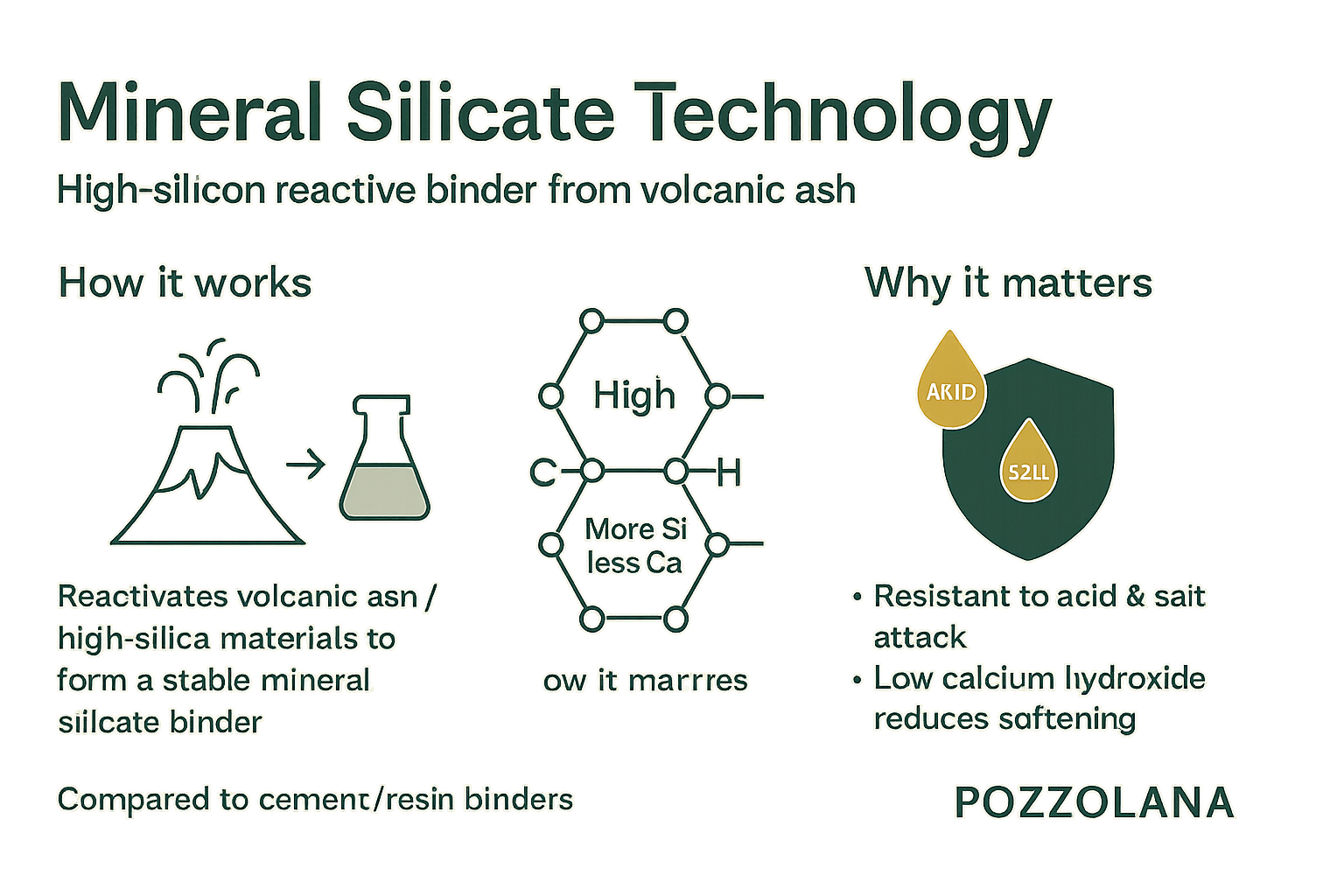
Pozzolana mineral silicate binder is formed by reactivating pozzolanic raw materials of high silicon content to create an exceptionally stable binding system which can overcome almost all of the weaknesses of cement and resin-based binders while simultaneously gaining additional properties and benefits.
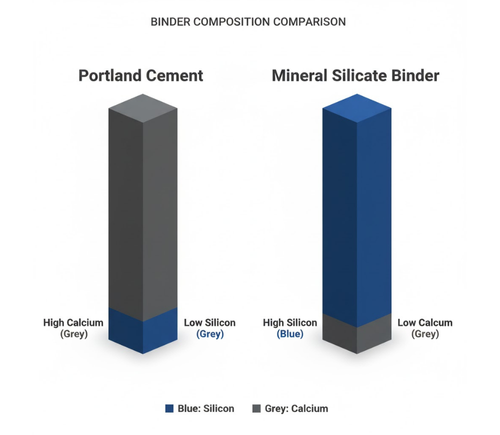
It contains much more silicon and much less calcium than cement. The high content of calcium hydroxide in hydrated cement is highly susceptible to chemical attack, causing cement mortar or concrete to deteriorate. Whereas hydrated mineral silicate binder contains much higher amounts of Calcium Silicate Hydrate (CSH) which is a very stable element.
Mineral silicate is a much more environmentally friendly alternative to conventional cement for non-structural use. It is made by simple blending process of volcanic-based natural materials and industrial byproducts to significantly reduce the carbon footprint when compared to cement production, while also being highly resistant to many chemical compounds.
Composition of Binders
Reducing Carbon Emissions
Traditional cement production is one of the largest sources of CO₂ emissions globally. Our mineral silicate technology dramatically changes this equation.
Technology Inside
Utilizing latent hydraulic and pozzolanic raw materials which are accrued during different industrial processes and activating them chemically.
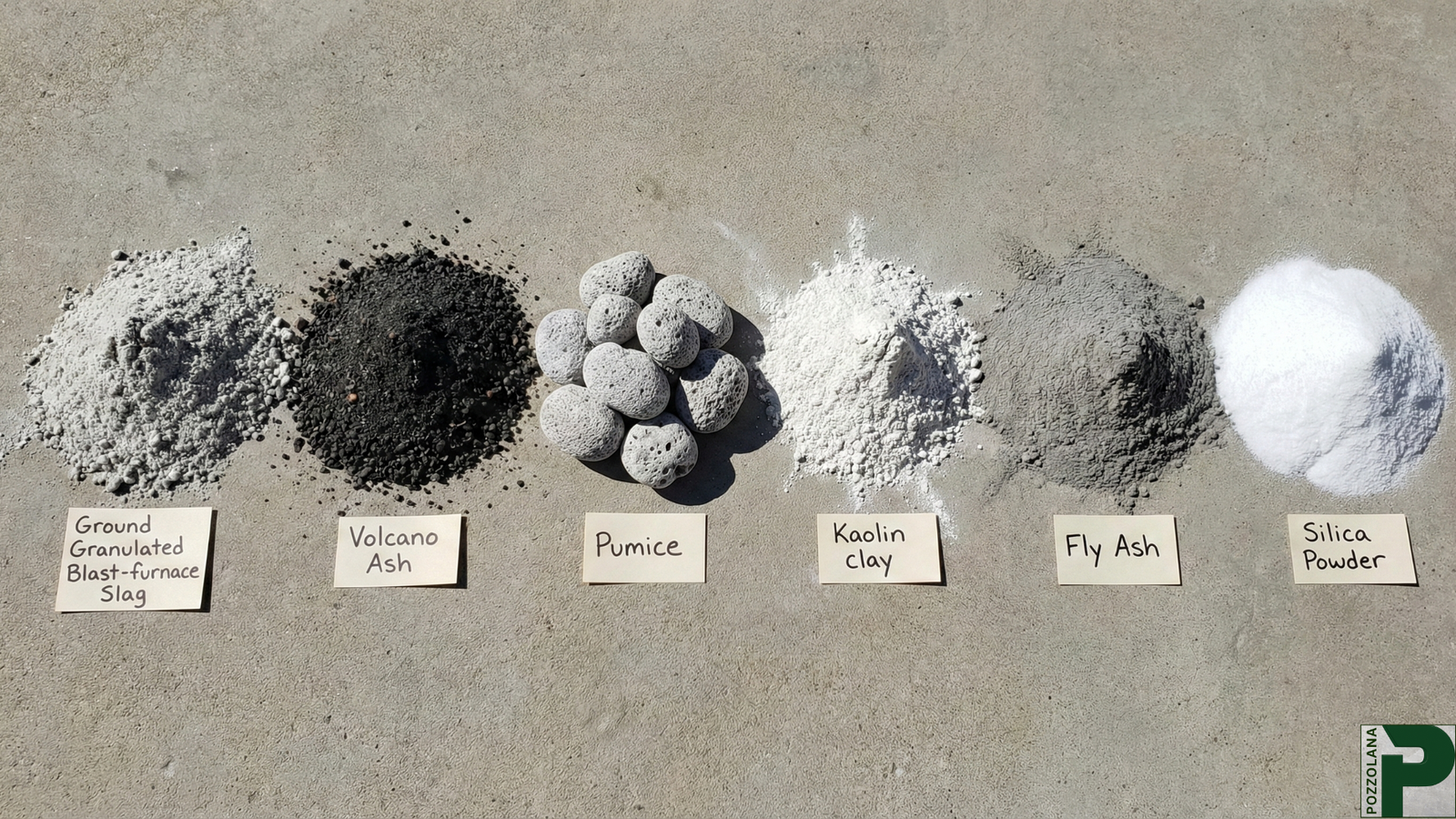
Use silicate-based materials that have a high Si⁺ content
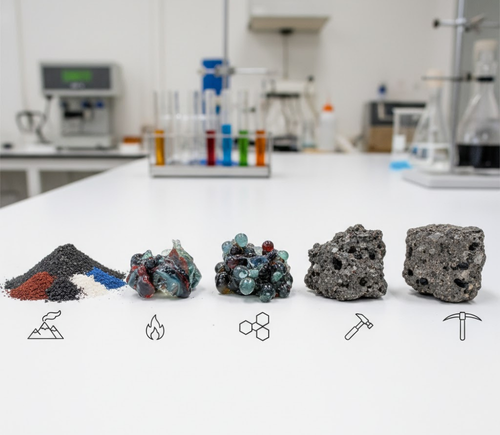
The reaction which creates the final product follows the cycle of rock formation in nature
Initial material preparation
Molecular restructuring
Accelerated reactions
Absorbs gases, salts, CO₂
Slowly becomes harder
Chemistry of Mineral Silicate
Ca(OH)₂ reacts with silicates and forms highly stable calcium silicate hydrate crystals (CSH-phases). These crystals create an exceptionally durable matrix that resists chemical attack and environmental degradation.
Mineral Silicate Advantages
Human-safe chemistry and minimal environmental impact, paired with strong performance.
VOC and APEO Free
Minimize the effects to human health and environment with zero volatile organic compounds.
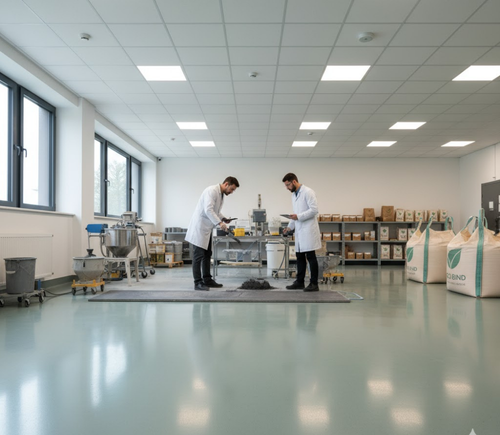
Application by Machines
Can be applied with a variety of machines for floors and walls efficiently.
Apply to Many Substrates
Can be applied on weak, moist, calcium sulphate and magnesium carbonate substrates.
Chemical, Salt Resistant
Stable in many high chemicals or salt environments without degradation.
Burnishable & Polishable
Can be burnished or polished to get more shiny, reflective surfaces.
Stable with Temperatures
Can be used in wide range of temperature environments or thermal shocks.
Flexible in Application
Can be transformed to many kinds of application to follow requirements.
Easy Pigmentation
Can be easily colored by powder or liquid pigments to create bright colors.
Problems We Have Avoided
Traditional flooring materials come with significant drawbacks. Here's what you won't experience with Pozzolana.
No Shrinkage
Cracks due to shrinkage do not occur, maintaining surface integrity over time.
No Joints
No saw-cut joints required on stable substrates, creating seamless surfaces.
No VOC or APEO
Indoor air quality remains high during and after application.
No Toxic Compounds
Not harmful during production, installation, or occupation.
No Odour
No noticeable smell during application, suitable for occupied spaces.
Low Carbon Emissions
Does not emit ozone-depleting substances during production or construction.
No Radiation
Contains no radioactive materials, completely safe for any environment.
Low Environmental Impact
Uses natural and renewable resources in production process.
No Efflorescence
Prevents powdery salts forming from surplus water on surfaces.
No Polymer
Purely inorganic matrix—not prone to polymer degradation over time.